
It is my privilege to meet and interview leaders in the entrepreneurial ecosystem. Recently, Joshua Cox “wing foiled” across False Bay. Here is his account and the lessons for entrepreneurs he learnt in achieving this with his friend.
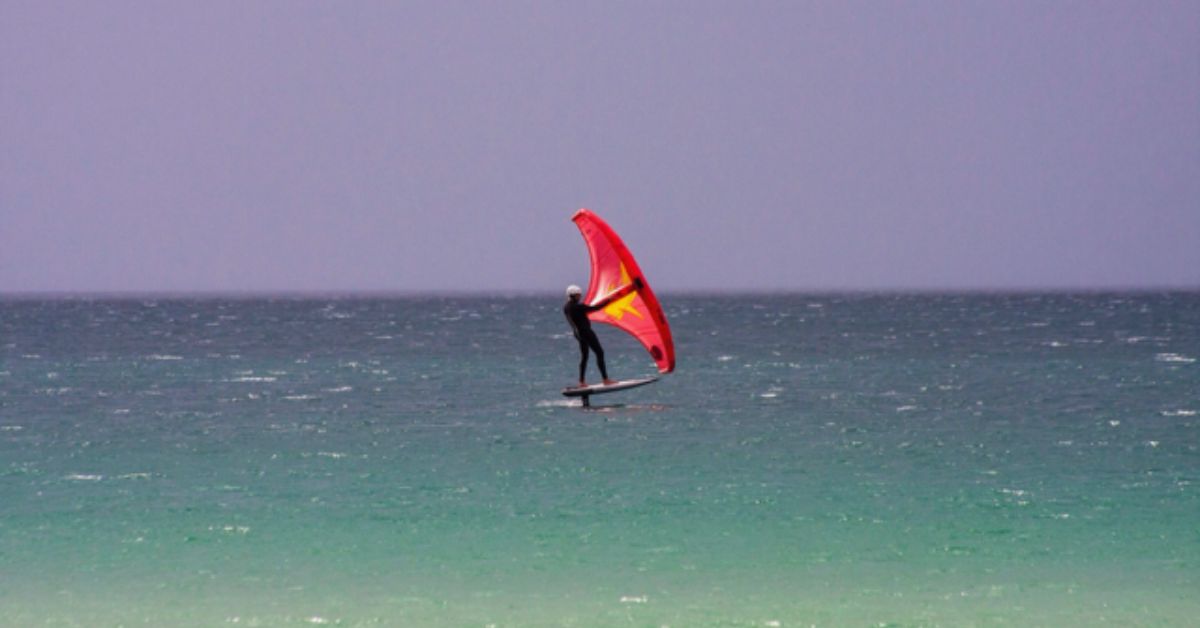
On the last day of January this year I fulfilled a lifelong dream. I crossed False Bay on a wingfoil, unsupported. Just me and a mate, out on the open ocean.
Both of us had butterflies as we set out. How long would it take? Would the conditions suddenly change? Would our bodies hold out? We had no idea.
Almost everything that actually happened once we were on the water was out of our control. All we could control was our decision to go, and the way we chose to go about it.
It was tempting to rush. To push hard across the bay as fast as possible. To get it done before the conditions shifted or fatigue crept in. To focus only on the far shore and on getting there. We decided to take a different approach. We took it slowly. We chose to enjoy it. We stopped often, sometimes for no reason other than to look around and take it all in. We made a point of laughing and celebrating the fact that we were doing it, even though the end was still far off and uncertain. In fact, because the end was uncertain and a long way away, we were even more determined to enjoy whatever moments came our way.
One of those moments was gliding through a pod of over 100 seals and dolphins feeding on a bait ball. We weaved between seals floating on the surface, resting and watching us pass. As I reached the far side of the bait ball, six or seven dolphins peeled away from the group and came to join me. They were right there, on my bow, speeding along just below and beside me while I glided along hovering above the water. I was shaking and hooting with excitement like a child. After a few hundred metres they spun back towards the main pod.
When we stopped, we really stopped. We took time. Time to look back and see how far the land had receded. This was our progress. We were actually doing it. Time to feel how small we were, out there with no one else around. Time to notice how clear and blue the water was. Time to get out of our heads and into our senses.
There is nothing that switches your senses on quite like being in a high-risk environment. We were conscious of every movement. When we fell, we were careful how we fell, aware of the need to protect our gear and our bodies. We were fully conscious of the fact that decisions mattered out there. Small choices had real consequences. That awareness sharpens you. It brings you into the present in a way few things do.
We had tried this crossing twice before and failed both times. Once from the other side of the bay, starting at Millers Point in a howling north wester. We wanted to make some distance into the bay, only to be turned back after two kilometres by impossible conditions. Another time, just a few weeks back, from Rooiels in very light wind. We bobbed and balanced for two hours before deciding to turn around, with only three hours of daylight left and the bulk of the journey still ahead of us.
Those earlier attempts mattered. They meant that not everything on this successful crossing was brand new. Some of it was familiar. We could recognise how much better the conditions were this time, which gave us the confidence to continue. Even the preparation felt familiar.
Afterwards, a friend asked me how I manage my nerves for something like this. For me, the simplest practice is to slow the body down. To take deep, long breaths. When packing, if I forget something, I make a point of not running back to the car. I walk. Slowly and calmly. I use my body to signal to my mind that there is no cause for panic.
In moment of stress it is easier to choose what our body does than what our mind does. And while our minds clearly influence our bodies – fear that tightens muscles and quickens breath – the influence runs the other way too. Our bodies can calm our minds. The signal functions in both directions. Slowing my body and breathing right down is often the most reliable way I know to quieten my racing mind.
This trip, like all the ventures I am drawn to build, was unique. No one had done it before. There was no time to beat. No one to compare ourselves to. No real risk in failing. But there was also no one to learn from, no manual, no guidebook. I think that is where growth lives, both in life and in business. In stepping into situations where outcomes are uncertain and the only real choice we have is our attitude and our approach.
Sometimes that means multiple attempts. Trying, pulling back, and trying again. Being patient. Paying attention. Taking lessons from each effort rather than forcing an outcome before it is ready.
Some people dream of experiences and careers with known outcomes. The holiday destination they return to again and again because it never disappoints. The clear career trajectory that follows once you understand the rules of the corporate ladder. Others are drawn to the unknown, to paths where you have no idea what delights or disappointments might lie ahead.
I am drawn to the latter. I want to put myself into situations where I do not know how, or even if, things will work out. I want to be surprised, both by the experience itself and by my response to it.
How will I show up when things are hard? How will I respond to uncertainty, discomfort, or fear?
Those questions cannot be answered from the safety of the harbour. You have to go out onto the open ocean to discover them.
What did this experience teach me as an entrepreneur?
- Great satisfaction can be found right in the middle of doing the hard thing; not only on the other side of it.
- The most worthwhile journeys are shared journeys. In business that might be with mentors, employees, family. Good times are most enjoyed when shared. Tough times are easiest to get through when shared.
- Don’t force the timing. The attempts that didn’t work, are still getting you there, even when it doesn’t feel like it.